1000 Sudoku Puzzles with 6 Levels V5: A Creator's Asset
Activity puzzle books remain one of the most reliable niches in low-content publishing, but the barrier to entry is often the sheer time required to generate quality interiors. For entrepreneurs and creators looking to enter this market, 1000 Sudoku Puzzles with 6 Levels V5 serves as a foundational asset designed to bridge the gap between idea and published product. This resource is not merely a collection of games; it is a structured production kit that addresses the specific logistical challenges of self-publishing. By providing a pre-organized interior across six distinct difficulty tiers, it allows users to bypass the technical learning curve of puzzle generation software and focus instead on marketing, cover design, and brand building.
Understanding the Resource Structure
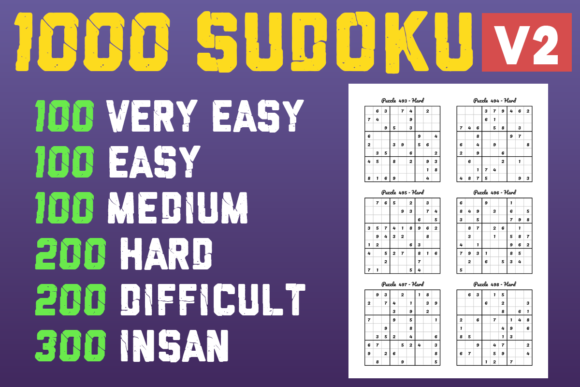
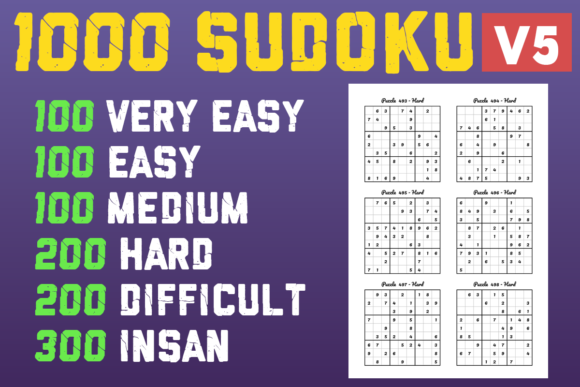
The core value of this package lies in its segmentation. Rather than offering a monolithic block of identical puzzles, the content is curated into a progressive difficulty curve that mirrors successful commercial puzzle books. The download includes a single PDF file ready for print formatting and a PPT file for editing or customization. The breakdown is intentional:
- 100 Very Easy Sudoku Puzzles: Designed for warm-ups, children’s sections, or senior cognitive maintenance.
- 100 Easy Sudoku Puzzles: Standard entry-level content for casual solvers.
- 100 Medium Sudoku Puzzles: The bridge level that retains engagement without causing frustration.
- 200 Hard Sudoku Puzzles: Substantial content for dedicated hobbyists.
- 200 Difficult Sudoku Puzzles: Advanced logic challenges for experienced players.
- 300 Insane Sudoku Puzzles: High-complexity grids that provide long-term value and differentiate the book from generic competitors.
This specific distribution acknowledges that a viable puzzle book requires variety. A book containing only "Insane" puzzles alienates beginners, while one with only "Easy" puzzles lacks retention for loyal customers. Having these levels pre-sorted saves dozens of hours in manual organization and validation.
Perspectives for Publishers and Entrepreneurs
For those focused on the business side of low-content publishing, speed to market and cost efficiency are usually the primary metrics. Creating 1,000 unique, valid Sudoku grids manually is mathematically complex and time-prohibitive. Even using automated generators requires learning scripting or navigating complex software interfaces. 1000 Sudoku Puzzles with 6 Levels V5 functions as an outsourcing solution. It converts what would typically be weeks of development time into an immediate next step.
Commercial viability also depends on perceived value. Customers expect professional formatting and logical progression. Because this asset includes editable PPT files, publishers can adjust margins, add branding elements, or insert solution pages without starting from scratch. This flexibility is crucial for creating a series rather than a standalone product. For example, a publisher might use the "Very Easy" and "Easy" sets to create a separate "Beginner’s Guide to Sudoku," while reserving the "Hard," "Difficult," and "Insane" sets for a "Master Class" edition. This ability to repurpose content maximizes the return on investment and supports a broader catalog strategy.
Educators and Cognitive Wellness Applications
Beyond commercial publishing, educators, therapists, and senior care providers evaluate puzzle resources through a different lens: utility and appropriateness. For these users, the six-level structure is a pedagogical tool rather than a sales feature. A tutor working with students on logical reasoning needs a scaffolded approach. Starting a student on "Insane" puzzles leads to discouragement, whereas staying too long on "Very Easy" fails to build new neural pathways.
In this context, the PDF format offers immediate usability. An educator can print specific pages for a lesson plan or cognitive assessment without needing to edit the source file. The clear delineation of difficulty levels allows for personalized learning plans. A therapist working with stroke recovery patients might utilize the first 200 puzzles (Very Easy/Easy) for fine motor skills and basic logic, gradually introducing Medium puzzles as cognitive function improves. Here, the reliability of the puzzle validity is paramount; an unsolvable grid undermines therapeutic trust. Pre-vetted collections remove the risk of errors that often occur when generating puzzles on the fly.
Evaluating Quality and Presentation Needs
Different users have different thresholds for what constitutes "quality." For a hobbyist creating a gift for a family member, the standard PDF layout may be perfectly sufficient. However, a professional KDP publisher must consider bleed, trim size, and paper opacity. While the provided files offer a complete interior, professionals should view them as a high-quality draft.
It is practical to test print a few pages from both the lower and upper difficulty spectrums before committing to a full print run. Ink coverage can vary between "Very Easy" puzzles (which have more given numbers and thus more ink) and "Insane" puzzles (which are sparser). Ensuring the paper stock handles the density of the "Insane" section prevents bleed-through issues. Furthermore, while the PPT file allows for editing, users should verify that fonts and spacing align with their specific brand guidelines. Consistency across a product line builds reader loyalty, and taking ten minutes to adjust headers or footers in the provided template ensures the final product feels bespoke rather than generic.
Making the Right Choice for Your Project
Determining whether 1000 Sudoku Puzzles with 6 Levels V5 aligns with your current objectives requires honest self-assessment regarding your technical skills and timeline. If you possess advanced coding skills and enjoy the process of algorithmic puzzle generation, creating your own interiors might be a preferred creative exercise. However, if your strength lies in niche research, keyword optimization, or cover design, spending time on interior generation is an opportunity cost.
Consider the following decision factors:
- Timeline: Do you need to launch within days or months? Immediate access favors pre-made assets.
- Customization Comfort: Are you comfortable modifying PPT layouts? If yes, this asset provides a massive head start. If no, you may still benefit from the PDF but will have less flexibility in branding.
- Volume Requirements: Is 1,000 puzzles enough for your planned series? For a single comprehensive volume, it is ideal. For a daily calendar or multi-year journal, you may need to combine this with additional resources.
- Audience Specificity: Does the six-level spread match your target demographic? A book specifically targeting "Expert Sudoku Masters" might find the 300 Insane puzzles useful but the 200 Very Easy/Easy puzzles unnecessary. Conversely, a general audience book benefits from the full spectrum.
Ultimately, this resource is designed to democratize access to the puzzle book market. It removes the technical gatekeeping that often prevents talented marketers and educators from producing physical goods. Whether used as a complete interior for a quick launch or as a modular component in a larger educational curriculum, the value proposition rests on its ability to convert time-intensive creation tasks into manageable, scalable assets. By handling the heavy lifting of content generation and organization, it frees up mental bandwidth for the strategic decisions that actually drive success in publishing and education.