Numbers Letters Shapes for Coloring: A Practical KDP Interior Solution
Creating a successful low-content book on Amazon KDP often comes down to two factors: speed to market and interior quality. For publishers targeting the toddler and preschool demographic, Numbers Letters Shapes for Coloring serves as a comprehensive foundational asset. This isn't just a collection of random clip art; it is a pre-formatted, 100-page interior specifically engineered for the "little hands" niche. When you are looking to build a coloring book that balances educational value with engagement, having a tested, bleed-ready template eliminates the most time-consuming phase of self-publishing.
The real value here lies in the versatility of the content. While the primary use case is obviously a standard coloring book, the inclusion of editable source files (AI and EPS) transforms this from a static product into a flexible design system. Whether you are a seasoned KDP publisher looking to expand your catalog or a parent-educator creating custom learning materials, understanding how to leverage these specific assets can significantly streamline your workflow.
Accelerating the Toddler Niche Workflow
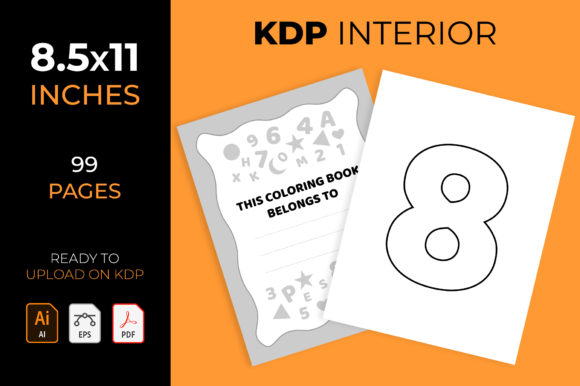
The toddler coloring market is saturated, which means differentiation and production speed are critical. A major bottleneck for many creators is formatting. Setting up margins, ensuring images don't get cut off during printing, and maintaining consistent spacing across 100 pages can take dozens of hours. This KDP interior arrives with bleed settings already configured for the industry-standard 8.5x11 inch trim size.
For publishers who release multiple titles per month, this ready-for-upload PDF acts as a reliable baseline. You aren't spending weeks testing margins or worrying about whether a shape sits too close to the gutter. The 99 pages of content plus necessary front matter have been validated, allowing you to focus entirely on cover design and keyword research rather than technical layout troubleshooting. This efficiency is particularly valuable when capitalizing on seasonal trends, such as back-to-school periods or holiday learning themes, where timing is everything.
Educational Applications Beyond Standard Publishing
While Amazon KDP is the primary destination, the utility of Numbers Letters Shapes for Coloring extends into homeschooling and early childhood education environments. Parents and educators aged 20–50 often seek resources that bridge the gap between play and structured learning. Because this interior includes editable AI Illustrator CC and EPS files, it offers adaptability that static PDFs cannot match.
Consider a homeschooling parent who wants to create a personalized workbook for their child. With the editable vector files, they can rearrange the sequence of letters to match their current curriculum or swap out specific shapes to align with a thematic unit, like "farm animals" or "geometry basics." Teachers in preschool settings can extract specific pages to create daily handouts or laminate them for reusable dry-erase activities. The ability to modify the source material means the resource grows with the child’s developmental stage, rather than being a single-use disposable product.
Strategic Customization for Market Differentiation
One common concern with pre-made interiors is the risk of duplicate content penalties or customer reviews noting that a book looks identical to others. This is where the included editable files become a strategic necessity. Simply uploading the PDF as-is is the baseline; true value comes from modification.
- Branding Integration: Use the AI file to add your unique logo, series name, or character mascot to the corner of each page, creating a cohesive brand identity across your KDP portfolio.
- Difficulty Scaling: Modify the stroke weight of the numbers and shapes to create distinct "Level 1" and "Level 2" versions of the same book, effectively doubling your product line from a single asset.
- Bilingual Adaptation: Edit the letter pages to include phonetic guides or translations, opening up new keyword opportunities and serving dual-language households.
- Thematic Overlays: Add simple background elements or borders to the clean vector shapes to transform a generic coloring book into a niche-specific title, such as "Space Shapes" or "Garden Numbers."
This level of customization ensures that while the structural foundation is outsourced, the final product remains unique to your publishing imprint.
Technical Considerations for Print Quality
When dealing with coloring books for toddlers, print quality directly impacts user satisfaction. Toddlers use crayons, markers, and colored pencils with varying degrees of pressure. The line art in this interior is designed with appropriate stroke weights to guide little hands without being overly restrictive. However, users should always order a physical proof before launching.
Even though the file is formatted with bleed, paper type matters. Standard KDP white paper is ideal for crayons and colored pencils, but if you plan to market the book for marker use, you might consider adding blank backing pages to prevent bleed-through. Since you have the editable source files, inserting blank interstitial pages is a simple task in Illustrator. Additionally, verify that the black levels are rich enough for KDP’s digital printing process; sometimes vector blacks need to be adjusted to ensure crisp lines on standard paperback stock. Testing the physical output ensures the "perfect for little hands" claim holds up in reality.
Evaluating Fit for Your Publishing Goals
Not every project requires a full 100-page pre-made interior. It is helpful to assess whether Numbers Letters Shapes for Coloring aligns with your current objectives. If you are building a high-ticket, premium educational series with proprietary illustrations, this asset might serve better as a supplementary practice workbook rather than your flagship title. Conversely, if you are building volume in the activity book niche or need a lead magnet to drive traffic to an email list, this interior provides immediate deployment capability.
Publishers should also consider the age appropriateness. The term "preschooler" covers a wide developmental range. Review the complexity of the shapes and letters in the preview. If the content skews younger (ages 1-3), it pairs well with thick-line, simple designs. If it targets pre-K (ages 4-5), you may need to utilize the editable files to add tracing lines or more complex patterns to maintain engagement. Understanding the specific developmental milestone you are targeting prevents mismatched expectations and negative reviews.
Maximizing Long-Term Asset Value
Treat this KDP interior as a component library rather than a finished book. The separation of numbers, letters, and shapes allows for modular reuse. A shape from page 20 might be perfect for a flashcard set, while the number layout could anchor a math worksheet bundle sold on a separate platform like Teachers Pay Teachers or Etsy.
By decoupling the content from the specific 8.5x11 book format, you extend the ROI of the purchase. The EPS and AI compatibility ensures longevity; unlike proprietary software formats that may become obsolete, these industry standards will remain accessible for years. For adult creators balancing publishing with other responsibilities, this modularity reduces future creation time. You aren't starting from scratch next time; you are iterating on a proven, tested foundation that already resonates with the toddler demographic.