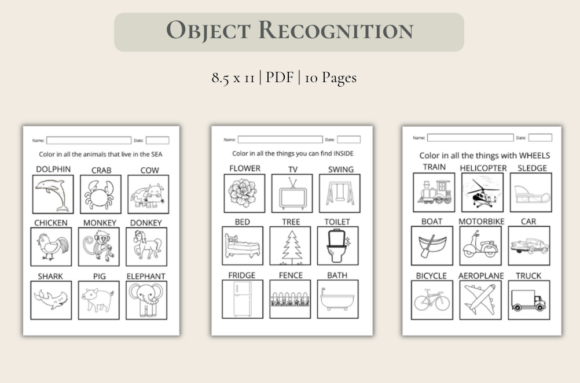
Object Recognition Activity Worksheets: Integrating Visual Learning with Creative Expression
The intersection of cognitive development and creative engagement is where effective educational tools truly shine. For educators, therapists, parents, and content creators seeking to bridge the gap between analytical skill-building and artistic expression, object recognition activity worksheets serve as a versatile medium. These resources go beyond simple identification tasks; they function as dual-purpose instruments that reinforce visual discrimination skills while satisfying the human desire for creative output. When learners engage with materials that allow them to color and learn simultaneously, retention rates often improve due to the multisensory nature of the task.
The Cognitive Mechanics of Coloring-Based Recognition
Understanding why these worksheets are effective requires looking at the neurological processes involved in object recognition. This skill is not merely about naming an item; it involves visual perception, memory retrieval, and categorical sorting. When a learner picks up a crayon or marker to complete an object recognition activity worksheet, they are engaging fine motor skills alongside visual processing. This kinesthetic component creates additional neural pathways associated with the target concept.
For professionals in occupational therapy and special education, this combination is particularly valuable. The act of coloring provides proprioceptive feedback that can help regulate sensory systems, making the cognitive load of recognition more manageable. For general educators and homeschoolers, it transforms a potentially repetitive drill into an enjoyable art project. The key lies in the design: the worksheet must offer enough structure to guide recognition but enough open space to allow for personalization and creative choice.
Designing for Diverse Learning Needs
Not all object recognition activity worksheets serve the same function. A resource designed for early childhood literacy differs significantly from one used in adult stroke rehabilitation or language acquisition for non-native speakers. Effective design considers line weight, complexity of the background, and the semantic relationship between objects. High-contrast lines support those with visual impairments, while intricate patterns may appeal to older learners seeking mindfulness alongside vocabulary reinforcement. The versatility of these worksheets allows them to be adapted across demographics, making them a staple in diverse educational and therapeutic toolkits.
Ten Unique Worksheet Concepts for Multisensory Learning
To maximize the utility of object recognition activities, it is essential to move beyond generic clip art. Below are ten distinct worksheet concepts that merge identification goals with coloring opportunities, suitable for various audiences ranging from preschool creators to adult hobbyists.
- Semantic Category Color Codes: Instead of random coloring, this worksheet assigns specific colors to categories (e.g., red for fruits, blue for vehicles). Learners must identify the object’s category before applying the correct color. This reinforces executive functioning and sorting skills alongside visual recognition, making it ideal for early elementary education and cognitive therapy.
- Real-World Texture Mapping: These worksheets feature realistic line drawings rather than cartoons. Users are instructed to color based on real-life textures and shading (e.g., wood grain, metal shine). This appeals to older students and artists, bridging the gap between scientific illustration and object identification while promoting observational accuracy.
- Hidden Object Camouflage Scenes: Objects are embedded within a complex, unified scene rather than isolated on a white background. Learners must visually scan and discriminate targets from distractors before coloring them. This builds visual figure-ground perception, a critical skill for reading readiness and daily living tasks.
- Part-to-Whole Assembly Coloring: Each page features separated components of a single object (e.g., wheels, chassis, steering wheel) that must be identified individually before being colored as a cohesive unit. This supports engineering-minded learners and helps develop spatial reasoning and systemic understanding of how objects function.
- Cultural Artifact Identification: Focusing on globally significant items, clothing, or tools, these worksheets combine social studies with visual recognition. Coloring traditional patterns and textiles adds cultural context, making this format excellent for ESL learners and diversity-focused curricula who benefit from associating vocabulary with visual heritage.
- Emotion and Expression Matching: Featuring faces or anthropomorphized objects displaying various emotions, users color based on feeling associations (e.g., warm colors for happy, cool colors for sad). This integrates social-emotional learning (SEL) with object recognition, serving therapists and counselors working on emotional literacy.
- Shadow and Silhouette Pairing: The worksheet presents both the detailed object and its solid shadow. Learners trace the connection and color only the detailed version, or vice versa. This strengthens abstract thinking and shape constancy, helping learners understand that objects remain the same even when lighting changes.
- Functional Association Chains: Objects are drawn in sequences showing use (e.g., seed, sprout, flower, vase). Coloring the progression reinforces temporal sequencing and functional logic. This narrative approach aids memory retention and is particularly useful for speech-language pathologists targeting verb-noun relationships.
- Negative Space Definition: The object is defined not by its own lines, but by the background patterns surrounding it. Learners color the background to reveal the object. This advanced perceptual task challenges the brain to process form differently, appealing to art students and neurodivergent learners who excel at pattern recognition.
- Bilingual Label Integration: Objects are paired with labels in two languages, with designated color zones for each linguistic group. This supports dual-language immersion programs and adult language learners, using color as a mnemonic device to separate and retain new vocabulary sets.
Practical Implementation Across Professional Domains
The application of object recognition activity worksheets extends far beyond the classroom. Business owners in the publishing and digital product sectors utilize these concepts to create high-value printable assets. Researchers in developmental psychology use modified versions of these worksheets to assess visual processing milestones without the pressure of standardized testing. Hobbyists and adult coloring enthusiasts find that themed recognition books provide a sense of purposeful relaxation, combining the meditative state of coloring with the satisfaction of learning new terminology or facts.
Considerations for Creators and Educators
When selecting or creating these resources, quality and intentionality matter. Avoid cluttered designs that overwhelm the user; white space is necessary for visual processing. Ensure that the objects depicted are culturally relevant and recognizable to the specific audience. For digital products, consider offering multiple file formats to accommodate different printing needs and screen-based interaction. Furthermore, always verify that the difficulty level aligns with the user's developmental stage—too simple leads to boredom, while too complex causes frustration. The goal is to maintain a state of flow where coloring enhances, rather than distracts from, the recognition task.
Enhancing Engagement Through Thematic Consistency
Thematic consistency amplifies the effectiveness of object recognition activity worksheets. When a series of worksheets follows a coherent narrative or subject matter, learners build a mental schema that facilitates faster recognition and deeper understanding. For example, a marine biology theme allows learners to connect fish, coral, and diving equipment within a single conceptual framework. This contextual learning is superior to isolated flashcard-style recognition because it mimics how the brain naturally organizes information.
Educators can leverage this by integrating worksheets into broader units of study. A lesson on community helpers becomes more memorable when students color police officers, firefighters, and mail carriers in action scenes rather than static portraits. Similarly, corporate trainers might use industry-specific recognition sheets to onboard employees, turning technical vocabulary acquisition into an interactive workshop activity. The tactile experience of coloring anchors abstract professional terms to concrete visual representations.
Adapting Materials for Accessibility and Inclusion
Inclusivity must be central to the design and use of object recognition activity worksheets. This includes providing alternative formats for users with motor difficulties, such as digital versions compatible with eye-gaze technology or switch access. For users with color vision deficiencies, ensure that color-coding tasks include secondary cues like patterns or symbols. Representation matters equally; worksheets should depict diverse people, environments, and objects to ensure all users see themselves reflected in the learning material. By prioritizing accessibility, creators and educators expand the reach and impact of these valuable tools.
Measuring Progress and Observational Insights
While worksheets are often viewed as practice tools, they also serve as informal assessment instruments. Observing how a user approaches an object recognition activity worksheet can reveal insights into their cognitive and motor development. Hesitation before coloring may indicate uncertainty in identification or decision-making. Consistent misidentification of specific categories might signal a need for targeted intervention. Conversely, fluid engagement and accurate color application demonstrate mastery and confidence.
Professionals can document these observations to track progress over time. Parents can use completed worksheets as tangible records of growth, celebrating milestones in both artistic expression and cognitive achievement. The physical artifact of a colored worksheet provides immediate, positive feedback that digital screens cannot replicate. This sense of accomplishment motivates continued engagement and reinforces the value of the learning process.
Fostering Creativity Within Structured Learning
One of the most significant advantages of combining coloring with object recognition is the preservation of creativity within structured learning environments. Traditional drills often suppress individual expression in favor of uniformity. Object recognition activity worksheets, however, invite personal interpretation. Two learners might correctly identify a tree but color it in vastly different ways—one realistic, one fantastical. Both have achieved the recognition goal, yet both have also exercised their unique creative voice.
This balance is crucial for maintaining long-term engagement. When learners feel ownership over their work, they are more likely to revisit the material voluntarily. For adults using these resources for stress relief or language learning, the creative element prevents the activity from feeling childish or tedious. It validates the user’s identity as a creator while supporting their goals as a learner. Ultimately, the most effective object recognition activity worksheets respect the intelligence and creativity of the user, providing a scaffold for growth rather than a cage for compliance.