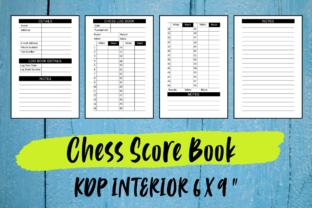
Chess Score Book KDP Interior: A Practical Guide to Quality and Usability
Launching a low-content publishing business often feels like a race to upload, but sustainable success in the chess niche requires slowing down to evaluate utility. When you select a Chess Score Book KDP Interior, you are not merely choosing a template; you are providing a functional tool for players who need to record moves accurately during competitive play or study sessions. The difference between a bestseller and a returned product usually lies in the specific design choices made before the file is ever uploaded. Understanding the nuances of this specific interior format ensures that your final product serves both the beginner learning notation and the club player analyzing games.
The Critical Importance of Trim Size and Margins
One of the most frequent oversights involves mismatching the interior dimensions with the intended user experience. This specific resource is formatted for a 6 x 9 trim size with no bleed. While 6 x 9 is an industry standard for trade paperbacks, applying it to a score sheet requires careful margin management. A common mistake is assuming that standard novel margins apply here. They do not. Chess score sheets require wider inner margins (gutter) than fiction books because the book must lie flat or be easily readable while open next to a chessboard.
If the gutter is too narrow on a 6 x 9 no-bleed interior, the score columns will disappear into the spine binding. Players will struggle to write in the left-hand column of right-side pages or the right-hand column of left-side pages. This renders the book frustrating to use during timed matches. Before finalizing your project, verify that the safe zone accounts for the physical thickness of a 121-page block. Even though there is no bleed, ensuring adequate white space around the scoring grid prevents ink from being lost in the fold and maintains a professional appearance that distinguishes your brand from amateur uploads.
Evaluating Notation Layouts for Real Gameplay
Not all chess score sheets serve the same purpose, and selecting the wrong layout is a significant usability error. Some interiors prioritize aesthetic minimalism over function, offering tiny boxes that cannot accommodate standard algebraic notation. Others use descriptive notation formats that have been largely obsolete for decades. When evaluating a Chess Score Book KDP Interior, confirm that the grid supports modern algebraic notation clearly.
Beyond basic move recording, consider the inclusion of auxiliary data fields. A high-quality interior should provide dedicated spaces for:
- Player Names and Ratings: Essential for tournament records and future analysis.
- Date and Event Location: Contextual metadata that helps players organize their game history.
- Time Control Settings: Crucial for distinguishing between blitz, rapid, and classical games.
- Result and Signature Lines: Necessary for official match verification.
Omitting these elements forces players to write critical information in margins or on separate scraps of paper, defeating the purpose of a dedicated score book. If the template you are considering lacks these fields, it may be better suited as a puzzle book rather than a functional score journal. Always test print a single page at actual size before committing to a full upload to ensure the writing area accommodates average handwriting.
Page Count Strategy and Binding Limitations
This particular interior contains 121 pages. For new publishers, this number might seem arbitrary, but it represents a strategic balance between value perception and manufacturing cost. A common misunderstanding is that "more pages equal better value." In reality, a 6 x 9 score book exceeding 150 pages can become unwieldy and difficult to keep open on a small tournament table. Conversely, books under 80 pages often feel insubstantial and may not justify the shipping cost for the buyer.
The 121-page count also interacts specifically with KDP’s printing options. At this length, you have flexibility in paper choice. However, be cautious when selecting cream paper for score books. While cream is excellent for reading text, it can reduce contrast for pencil marks and make erasures more visible. White paper is generally superior for score sheets where clarity and legibility are paramount. Additionally, verify that the page count aligns with your pricing strategy. Printing costs fluctuate based on page count thresholds; staying within optimized ranges ensures your royalty remains healthy without inflating the customer price beyond market expectations.
Technical Verification Before Upload
Even a perfectly designed interior can fail due to technical oversight. "Ready for printing" claims should always be verified through personal testing. PDF files can sometimes shift during export or compression. Before uploading this 121-page PDF, perform a thorough pre-flight check.
- Check Page Dimensions: Ensure the document setup is exactly 6 x 9 inches. Even a 0.01-inch discrepancy can trigger automated rejection or scaling warnings.
- Verify Font Embedding: Unembedded fonts can render incorrectly on different systems. Flatten the PDF or embed all typefaces to guarantee the score grids appear crisp.
- Inspect Line Weights: Hairline borders that look fine on screen may print too faintly on standard offset presses. Ensure grid lines are at least 0.25pt to guarantee visibility on physical paper.
- Confirm Blank Pages: If the interior includes intentional blank pages for notes or diagrams, ensure they are truly blank and not carrying hidden artifacts that increase print costs.
Skipping these checks leads to rejected submissions or, worse, approved books with printing defects. Taking thirty minutes to validate the technical specifications saves weeks of customer service headaches and protects your publisher reputation.
Aligning Product Description with Interior Reality
Marketing misalignment creates dissatisfaction faster than poor design. When listing a Chess Score Book KDP Interior, your description must accurately reflect the 6 x 9 no-bleed format. Do not describe the book as "large format" or "tournament size" if it is a compact 6 x 9 volume. Tournament players often expect 8.5 x 11 sizes for official events; misleading them results in negative reviews citing size discrepancies.
Instead, position this specific trim size correctly. Highlight its portability, suitability for casual club play, home study, and travel. Emphasize that the no-bleed design maximizes usable writing space within a compact footprint. Accurate positioning attracts the right audience—hobbyists, students, and travelers—who specifically want a portable solution rather than a bulky tournament ledger. Honest marketing builds trust and reduces return rates.
Making Informed Decisions for Long-Term Success
Success in low-content publishing comes from treating each product as a solution to a specific problem rather than a generic commodity. When utilizing this Chess Score Book KDP Interior, remember that your end user is holding a pen and focusing intensely on a game. Every design element, from margin width to line darkness, impacts their concentration and record-keeping accuracy.
By avoiding common pitfalls regarding sizing, notation standards, and technical validation, you elevate your offering above the saturated baseline of low-effort uploads. Test thoroughly, understand the physical constraints of the 6 x 9 no-bleed format, and respect the functional needs of chess players. This deliberate approach transforms a simple PDF file into a reliable product that earns positive reviews and establishes your credibility in the chess publishing niche. Quality assurance is not just about meeting platform requirements; it is about respecting the customer's intent and delivering genuine utility.